Cleaning dirty water is one of the quiet triumphs of modern life. It also comes with a hidden cost: the tanks and lagoons that treat our sewage breathe out a steady stream of greenhouse gases. A new study out of Australia points to a low-cost way to turn that down, and it is the kind of fix a small borough along the Mon or the Casselman could actually afford.
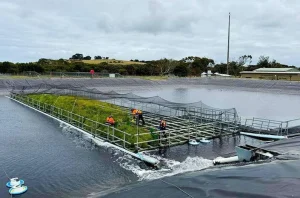
Researchers at RMIT University in Melbourne floated a raft of native plants on a working wastewater lagoon and watched its emissions for two years. Carbon dioxide fell by up to 36 percent, methane by up to 66 percent, and nitrous oxide by up to 18 percent, for an overall greenhouse gas cut of up to 31 percent. The gains showed up within four to seven months, well before anyone expected them.
The problem hiding in the treatment plant
Wastewater treatment does not usually make anyone’s list of climate worries, but it should. Treatment plants and their lagoons account for roughly 1.6 percent of global greenhouse gas emissions, and that share is set to climb as more of the world builds proper sanitation. The trouble is not carbon dioxide so much as the other two gases coming off the water. Methane and nitrous oxide are far more potent, molecule for molecule, and both are a normal byproduct of the microbial work that breaks down waste. In short, the process solves one environmental problem while creating another.
That matters here because a great many of the small systems across the Upper Ohio Basin are lagoon systems. Rural boroughs and townships in Pennsylvania, Ohio, West Virginia, and Maryland often treat their sewage in open ponds rather than in the concrete-and-steel plants you find in cities. Those ponds are cheap to run, which is exactly why small communities use them, and they are also the kind of open water where a fix like this one can be dropped straight in.
What the researchers tried
The idea they tested is called a floating wetland. It is a buoyant mat planted with native vegetation, set on the surface of the water so the roots hang down into it. The plants and the community of microbes that gather on their roots take up nutrients and change the chemistry of the water below. The team, led by Lukas Schuster, installed one about the size of one and a half tennis courts on a wastewater lagoon and then measured what came off the surface, month after month, for two full years.
They had expected the climate benefit to arrive slowly, only after the plants had pulled enough nutrients out of the water. Instead the emissions started dropping almost right away.
The drop in methane coming off a single wastewater lagoon after a floating wetland was installed, with overall greenhouse gases down as much as 31 percent.
“One of the biggest surprises was how quickly greenhouse gas emissions declined.”
Lukas Schuster, researcher, RMIT University
A fit for small systems, and for farm ponds too
The appeal of this approach is that it does not ask a cash-strapped water authority to tear anything out or pour new concrete. A floating wetland sits on top of the water a system already has. It works with existing infrastructure, it scales up or down with the size of the pond, and the plant list can be drawn from species that already grow along the water nearby. The researchers note that the same trick should carry over to other kinds of high-emission water bodies, including the farm ponds that dot an agricultural region like ours.
None of this is a finished, off-the-shelf product yet. It is one well-measured pond over two years, and the headline numbers are best-case figures rather than a guarantee. What it offers is a credible, affordable direction for a problem that most small operators did not even know they had.
Why it matters for the rest of us
Clean water and a stable climate are usually treated as two separate fights, funded from two separate pots. Work like this is a reminder that they are often the same fight, and that the cheapest answers tend to look a lot like the plants that were growing along the water in the first place. For a network built around small communities and their creeks, that is a welcome thing to keep an eye on. A raft of cattails may not sound like climate policy, but for a borough lagoon it might be the most practical version we get.
Reporting drawn from Anthropocene Magazine’s coverage of a 2026 study led by Lukas Schuster of RMIT University, published in the Journal of Environmental Management. Emission figures are the study’s reported reductions. Current as of September 28, 2026.