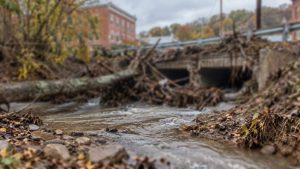
After a brutal stretch of flash floods this summer, the city of Washington is about to start digging its streams back out. In the next several weeks, crews and volunteers will begin pulling the fallen trees, branches, and sediment out of culverts and streams across the city, most of it by hand, in an effort to lower the odds that the next big rain does the same damage all over again.
Four intense flash floods hit the Washington area across August and September, and they left culverts and streams across the city choked with debris, fallen trees, and sediment. Some culverts are blocked by more than a foot of material, which chokes off water flow and raises the risk the next storm floods again. The city plans to start a cleanup within the next several weeks, done mostly by hand, with local nonprofits helping assemble volunteer teams. The work waited on the Pennsylvania Department of Environmental Protection, which met with city officials in person and spelled out the ground rules: hand cleanup is fine, but heavy machinery has to stay out of the water.
What happened, and why now
The region took a beating this summer. Four separate flash floods swept through the Washington area in August and September, part of a run of record rainfall that pushed the mayor to declare a state of emergency. When the water dropped, it left behind the usual wreckage in the wrong places: trees down across channels, branches jammed in grates, and sediment packed into culverts. City officials who toured the sites found some culverts blocked by over a foot of debris. That matters because a clogged culvert is a smaller culvert, and a stream that cannot move water during a storm sends it somewhere else, usually into basements, streets, and yards. Clearing the blockages now is an attempt to get ahead of the next flood rather than clean up after it.
Why the city waited for the state
This is the part worth paying attention to, because it is a lesson for every community in the basin tempted to grab a backhoe after a flood. Cleaning debris out of a stream sounds simple, but running heavy equipment into the water is not. Under state rules, putting machinery into a stream can trigger the Department of Environmental Protection’s dredging permit process, which brings permits and environmental review along with it. So the city held off until it could sit down with DEP, which it finally did in person after a stretch of virtual meetings. The guidance that came out of that meeting: do the work by hand where possible, and keep the large equipment up on the bank beside the creek rather than down in it. Mayor JoJo Burgess came out of the session optimistic and said it gave the city much-needed clarity. City Administrator Rich Cleveland, the city engineer, DEP staff, and a representative from state Senator Camera Bartolotta’s office all walked the sites together.
How residents can pitch in
Because so much of the work has to be done by hand, people power matters here. Local nonprofits are helping pull together volunteer cleanup teams, and the city plans to help homeowners and business owners understand what they are allowed to clear on their own property versus what belongs to the city or the state. If you own property along one of these streams and are not sure what you can touch, the city is pointing people to the mayor’s office with questions rather than guessing. It is a sensible split: the rules that protect a stream from careless dredging also apply to a well-meaning neighbor with a chainsaw.
Why it matters for the rest of us
Washington’s main waterway is Catfish Creek, and what is playing out there is a story the whole Upper Ohio Basin knows by heart. Older towns built right up against their streams, decades of debris and deferred maintenance, and storms that keep getting heavier. Clogged culverts quietly turn an ordinary downpour into a flood, and the fix is rarely glamorous: show up, clear the channel, and do it without wrecking the stream in the process. Washington is doing it the right way, by hand and by the rules, and that is worth watching for any community that has ever bailed out a basement. Clear one culvert at a time, and a town gets its breathing room back.
Based on reporting by the Observer-Reporter, “Washington to begin stream cleanup in coming weeks,” October 19, 2026, with details on the summer flooding corroborated by WPXI and CBS News Pittsburgh. Officials named include Mayor JoJo Burgess, City Administrator Rich Cleveland, and a representative from state Senator Camera Bartolotta’s office, alongside Pennsylvania DEP staff. Current as of October 20, 2026.