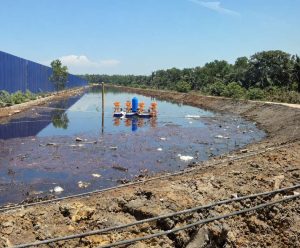
When DEP published its long-awaited study of radioactivity in landfill leachate this spring, the headline was reassurance. Mountain Watershed Association has now read the fine print, and its October 13 analysis argues the study answers less than it claims, especially for the landfills in the Youghiogheny watershed.
Pennsylvania DEP’s March 2026 report on radium in leachate from the state’s 49 landfills, many of which accept oil and gas drilling waste, concluded no landfill exceeded the regulatory threshold. Mountain Watershed Association’s new critique says DEP measured against a nuclear-facility wastewater standard of 600 picocuries per liter, used averages that smoothed over six individual samples above that line, and never performed a formal risk assessment. Three of the higher-ranking landfills sit in the Yough watershed.
What DEP found, and how
The study sampled raw, untreated leachate over two years, screening with gamma spectroscopy and following up with radiochemistry. The context is Pennsylvania’s drilling waste, roughly 80 percent of which stays inside the state, much of it landing in municipal landfills. DEP compared results to the federal Nuclear Regulatory Commission’s 600 picocuries per liter threshold and reported that no landfill exceeded it on an annual average basis. Secretary Jessica Shirley summed up the agency’s reading plainly.
“The takeaway here is that there is no risk to human health from radiation in landfill leachate.”
Jessica Shirley, Secretary, Pennsylvania Department of Environmental Protection
Where MWA says the reassurance thins out
The association’s analysis, written by Em Hough, raises four objections. First, the 600 picocurie standard was built for tightly monitored facilities like nuclear plants, not municipal landfills. Second, annual averaging hid the six individual samples that did exceed the threshold. Third, the testing methods assume fairly clean water, and oil and gas contamination can interfere with the chemistry enough to mask radium. Fourth, the report contains no formal risk assessment and no independent public health review, so the no-risk conclusion rests on a comparison, not an analysis of how people might actually be exposed.
Individual leachate samples that exceeded the 600 picocuries per liter threshold, smoothed out of view by annual averaging, according to MWA’s review of the data.
The Yough connection
This is not an abstract exercise for our basin. By MWA’s reading of the data, MAX Environmental in Yukon ranked third statewide with an annual average of about 453 picocuries per liter, Kelly Run Sanitation in Elizabeth ranked sixth at about 436, and Valley Landfill in Irwin tenth at about 397, with Greenridge Reclamation in Scottdale also in the study. MAX Environmental is the state’s only permitted hazardous waste landfill and operates under two EPA consent orders. Leachate from these facilities does not stay on site; it moves on to treatment and, eventually, to the watershed.
Why it matters for the rest of us
Whatever one concludes about the health question, the process question stands: a study that reassures the public should be able to show its work. MWA is circulating a petition asking DEP to acknowledge the gaps, and hosts monthly meetings in Yukon on the MAX Environmental consent orders and its Sewickley Creek sampling. Groups with a landfill in their watershed, and most of us have one, can start by asking where its leachate goes.
Based on Mountain Watershed Association’s analysis by Em Hough, October 13, 2026, reviewing the Pennsylvania DEP radium in leachate report of March 13, 2026. Current as of October 16, 2026.