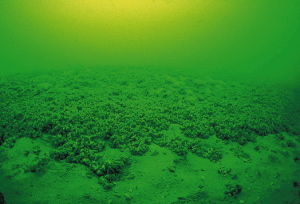
For a few years in the early 1990s, Lake Erie looked better than it had in a generation. The water ran clear enough to see the bottom in places where nobody had seen it for decades. The reason was a fingernail-sized invader, and the clear water turned out to be a warning sign, not a recovery.
A new 96-second explainer from the YouTube channel WATOP walks through how zebra mussels, by the billions, filtered so much plankton out of Lake Erie that the water roughly doubled in clarity while the food web underneath it fell apart. The chain reaction ran from vanishing plankton to starving fish, rotting algae mats on beaches, and botulism outbreaks that killed large numbers of birds. It is a sharp reminder that clear water and healthy water are not the same thing, and that the mussels are no longer just a Great Lakes problem.

A filter the size of a fingernail
The video starts with the arithmetic. Each zebra mussel works as a tiny filter, pulling roughly a third of a gallon of water through its body every day and straining out the microscopic plants and animals floating in it. One mussel does not matter much. Billions of them, carpeting rocks, intake pipes, and the lake bottom, add up to a filtration system that can process an enormous share of a shallow lake.
Lake Erie, the shallowest and most productive of the Great Lakes, was a perfect target. According to the explainer, diatoms, the single-celled algae at the base of the food web, dropped by 82 to 91 percent, and the water became about twice as clear as before. To anyone standing on a dock, that looked like a cleanup that nobody had to pay for.
Clear is not the same as healthy
The mussels were not removing dirt. They were removing food. Plankton feeds the tiny shrimp-like animals that feed young fish, and as the mussels stripped it from the water, the effects worked their way up. The video points to Diporeia, a small crustacean that was once a staple for Great Lakes fish, collapsing by tens or even hundreds of times in some areas, and to fish going hungry as a result.
Then the clear water caused a problem of its own. Sunlight reached much deeper, and the nutrients the mussels left behind were concentrated near the lakebed. That combination suited Cladophora, a filamentous green algae that grew into huge mats in the shallows. When those mats tore loose, they washed ashore and piled up on beaches in thick, rotting heaps. The water looked cleaner while the shoreline got worse.
From gobies to botulism
The last link in the chain is the most surprising. Round gobies, another invader, began feeding heavily on the mussels. Bigger fish ate the gobies, and waterbirds ate those fish. That new food chain turned out to be an express route for botulism toxin, which moved from the lake bottom into the birds. The Great Lakes saw major botulism outbreaks, with large numbers of birds killed.
None of this was planned or predicted when the mussels first turned up. That is the point of the story: an invasive species does not just add one new animal to a system. It rewires who eats whom, and the consequences can take years to surface.
Why it matters for the rest of us
Lake Erie is Pennsylvania’s own Great Lake, and zebra mussels did not stay there. They have spread into the Ohio River system, where they foul water intakes and compete with the native freshwater mussels our rivers are slowly getting back. The tool that slows them down is simple: clean, drain, and dry every boat, kayak, trailer, and bait bucket before it goes from one water body to another. There is a lesson closer to home, too. Anyone who has stood beside a stream running crystal clear over orange-stained rocks below an old mine already knows that the clearest water in the basin is sometimes the emptiest. Healthy water is supposed to have a little life in it.
Based on the narration of “How Zebra Mussels Made Lake Erie Too Clean,” a short explainer video published October 14, 2026, by the YouTube channel WATOP, linked above. Figures are as cited in the video. Current as of October 15, 2026.