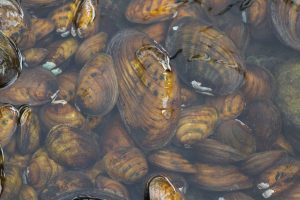
Pennsylvania now has a statewide conservation plan for its freshwater mussels, the unglamorous animals that filter our rivers for free. The Western Pennsylvania Conservancy and the Pennsylvania Fish and Boat Commission built the new Pennsylvania Freshwater Mussel Conservation Plan on five years of statewide surveys and a database of mussel records reaching back to 1838.
The new plan, funded by the National Fish and Wildlife Foundation, gives conservation professionals, stream landowners, and watershed groups baseline data and guidance for deciding where mussel conservation will do the most good. A free Western Pennsylvania Conservancy webinar on November 16 walked through the plan, and the recording is available to watch.
Five years of wading, records back to 1838
Biologists call mussels river livers, because a healthy mussel bed filters water all day as the animals feed and breathe, pulling sediment and algae out of the current and passing cleaner water downstream. Pollution from industrial waste and farm runoff, along with climate change, has sharply reduced mussel populations across the state. To know what is left, the Conservancy and the Fish and Boat Commission spent five years surveying river basins statewide, then combined that fieldwork with every known Pennsylvania mussel record from 1838 through 2024. The result is both a plan and a database: a baseline for what lives where, and guidance on which waters deserve attention first.
The earliest year in the plan’s statewide database of Pennsylvania mussel records, which runs through 2024.
A mussel that needs a salamander
The same week the plan was making the rounds, The Allegheny Front reported on field crews surveying for a salamander that one of the state’s imperiled mussels depends on to reproduce. Mussel larvae spend their first days clamped onto the gills of a host animal before dropping off to start life on the river bottom, and for most species the host is a fish. When the host disappears from a stretch of river, the mussel stops reproducing there no matter how clean the water gets. It is a reminder that mussel conservation means conserving whole river communities, not single species.
What a watershed group does with this
The plan is written for people who manage or care for a piece of a stream: land trusts, conservation districts, municipalities, and volunteer groups like the ones in this network. The baseline data shows where healthy beds survive, where they used to be, and where restoration or protection would help most. If your group monitors water quality in the Allegheny, Mon, or Yough country, the mussel records for your water are worth a look before you plan next season’s work. The November 16 webinar recording is a good one-hour introduction.
The filter is a living thing
We spend real money building things that do what a mussel bed does for nothing. Pennsylvania losing its mussels would mean paying for that work forever; keeping them means protecting hosts, habitat, and water quality together. Now, at least, there is a plan for doing it, and nearly two centuries of records to measure the effort against.
Sources: the Western Pennsylvania Conservancy’s Pennsylvania’s New River Livers Plan webinar page and November 16, 2026 recording, and reporting by Julie Grant for The Allegheny Front, November 13, 2026. Current as of November 20, 2026.