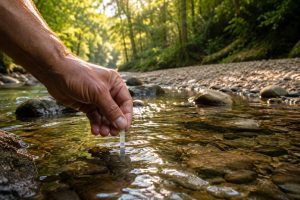
A quick but time-sensitive heads up for anyone who has been monitoring with Salt Watch this year. The deadline to get your data into the 2025-2026 Salt Watch Annual Report is July 1. If you have readings sitting in a notebook or on your phone, now is the time to upload them.
It is easy to think of road salt as a winter problem, but it does not simply wash away when the snow melts. The Cary Institute of Ecosystem Studies has found that salt can linger in the environment for decades after it is applied, and summer droughts and low water levels often concentrate it into sharp chloride spikes. In other words, a stream can look perfectly clear and still be carrying a heavy load of salt.
That is what makes steady, year-round monitoring so valuable. One reading is a snapshot. A season of readings is a baseline, and a baseline is what lets us spot a sudden change and speak up for a stream when something goes wrong. Volunteers across the Upper Ohio River Basin are the first line of defense here, and the annual report is only as strong as the data behind it.
Two ways to help before July 1
- Submit your data. Upload any remaining water quality readings to the Clean Water Hub before July 1.
- Share your story. Hosted an event, ran a local salt cleanup, or captured great monitoring photos? Send your stories and images to saltwatch@iwla.org by July 1 to be featured in the report.
New to Salt Watch?
If you have been meaning to start, it is an easy program to join. You can request a free Salt Watch kit at saltwatch.org, and if you ever detect a pollution problem, the League’s Advocacy Guide walks you through practical steps you can take. For community watershed groups across Pennsylvania, Ohio, West Virginia, and Maryland, it is one of the simplest ways to put real numbers behind what is happening in your local waters.
The clock is ticking on this one. Get your readings in by July 1, and help make this year’s report the most complete picture yet of salt in our region’s water.