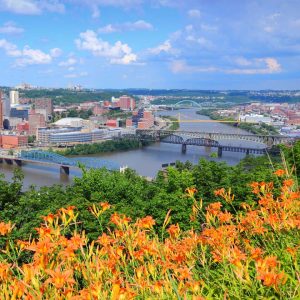
How healthy are our rivers? It’s one of the most common questions people ask, and our partners at Three Rivers Waterkeeper have spent a year gathering data to help answer it. Their newly released 2025 State of Our Waters Report takes stock of the Allegheny, Monongahela, and Ohio Rivers and their tributaries, the same waters that form the headwaters of the Ohio River Basin we all share.
Over the course of 2025, the group logged serious time on the water and ran a wide range of tests, from E. coli and chloride to PFAS. The short version, in their telling, is a mixed one: many creeks and streams are sitting within healthy ranges, while some spots are still hit hard by pollution, some of it ongoing and some of it legacy from the region’s long industrial history.
By the numbers
- 765 hours spent monitoring waterways
- 476 water samples collected
- 95 water quality parameters analyzed
- 78 locations sampled across the region
- A continuous monitoring buoy running on the Beaver River from April to November 2025, building long-term trend data
The swim question
Three Rivers Waterkeeper’s best-known testing is Swim Guide, which checks popular recreation spots for E. coli, the bacteria that signals sewage in the water. In 2025 they pulled 235 samples from 35 sites over 21 weeks. The results are a reminder of how much work is left: only 32% of samples passed, and not a single site passed all 21 weeks.
What’s living in our waterways
The report isn’t all warnings. A project called “What’s Living in Our Waterways” surveyed six local tributaries and turned up more than 100 species, including great blue herons, salamanders, water snakes, and toads. Those findings became a pocket field guide and an ArcGIS storymap. For a region shaped by extraction and pollution, that kind of biodiversity is a sign of how resilient these rivers can be when we look after them.
The full report digs into all of this and more. You can read it at 3RWK.org/SW2025. Work like this is exactly why the network matters: the more we understand about the headwaters, the better we can protect every mile downstream.