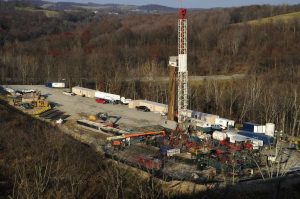
Every working oil or gas well brings up more than oil and gas. It brings up salty, often radioactive water from deep underground, and Pennsylvania law requires well owners to report how much of that waste they produce and where it goes. For 2025, the owners of roughly 81,000 conventional wells reported nothing at all about their waste. That gap runs straight through the Upper Ohio basin.
An August report by the FracTracker Alliance found that tens of thousands of conventional wells reported producing oil or gas in 2025 but reported no waste. The Department of Environmental Protection confirmed that it received no waste information for about 81,000 of the roughly 105,000 conventional wells required to report. DEP says some of those wells may truly have had no waste to report, since waste stored on site does not count until it is disposed of. It also says it is looking at changing its reporting system so operators must explain a blank waste report. Until that happens, nobody can say with confidence how much brine these wells are producing or where it ends up.
What the numbers show
Pennsylvania has two very different oil and gas industries. The shale side, with about 12,800 unconventional wells, reported roughly 3 billion gallons of liquid waste in 2025. The conventional side, the older, shallower wells that dot the hills of western Pennsylvania, is far larger by well count. FracTracker’s analysis found about 71,700 conventional wells reported production, but only about 23,200 reported any waste. Together those reporting wells listed about 42.7 million gallons of contaminated water.
That figure is almost certainly low. PA Environment Digest, which reported on the findings in early October, ran the math on the wells that produced oil or gas but left the waste line blank and estimated they could account for roughly 100 million gallons more. An earlier analysis of 2017 data found conventional operators reporting about 93 million gallons that year, more than double what was reported for 2025.
Conventional oil and gas wells whose owners reported no waste information to DEP for 2025, out of roughly 105,000 required to report.
DEP’s response
DEP told PA Environment Digest that it has been stepping up enforcement on reporting, though its 2026 actions focused mainly on wells that failed to report production or file mechanical integrity assessments. The department said waste reporting is also important, and that it is considering reaching out to conventional operators who reported production but no waste for 2025. It also plans to look at requiring a comment whenever no waste is reported, which its current system does not do.
The department offered a less alarming explanation for many of the blanks: some wells may have stored their waste on site, or produced so little that none was disposed of during the year.
“Based on the available information, it is plausible that the most frequent reason for not reporting waste is that no reportable waste was generated during the reporting period.”
Pennsylvania Department of Environmental Protection, in a statement to PA Environment Digest
Even so, this is not a new problem. A DEP compliance report in 2022 found that only about 30 percent of conventional operators reported production or well integrity information on time.
Why it matters for the rest of us
Conventional well brine is not harmless water. A 2022 Penn State study funded by DEP found it can contain at least 25 chemicals above environmental and health standards, radium above industrial discharge limits, and about two and a half times the salt of seawater. Some of it has historically been spread on dirt roads for dust control, where rain carries it toward the nearest creek. Many of Pennsylvania’s conventional wells sit in the Allegheny, Clarion and Kiski watersheds, which feed the drinking water intakes downstream in the Pittsburgh region.
Watershed groups monitoring those streams depend on good data to know what to look for. When most of an industry leaves the waste line blank, a monitoring crew is working with half a map. DEP’s proposed reporting fix is a sensible, low cost step, and it is worth encouraging. A blank line on a form should at least come with a reason.
This article draws on the FracTracker Alliance report Tracking Pennsylvania’s Oil and Gas Waste in 2025, by Matt Kelso, and reporting by PA Environment Digest, including statements from the Pennsylvania Department of Environmental Protection. Current as of October 26, 2026.