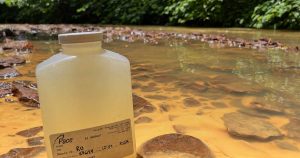
For generations, acid mine drainage has been the defining wound of the Monongahela. A new study using more than a decade of independent monitoring data delivers a rare and welcome headline: on the river’s mainstem, that wound is slowly healing.
The West Virginia Water Research Institute analyzed long-term Three Rivers QUEST monitoring data from 16 sites across the Monongahela basin. Across most of them, the chemical signatures of mine drainage are holding steady or improving, not getting worse. Sulfate, total dissolved solids, iron, and manganese are trending down at many sites, while pH and alkalinity are trending up.
What the study looked at
The study, produced by the West Virginia Water Research Institute and published as an interactive StoryMap alongside a 2025 paper in the Journal of Contemporary Water Quality Research and Education, tracks the fingerprints of acid mine drainage down the length of the Monongahela. The river runs roughly 130 miles from north-central West Virginia into southwestern Pennsylvania, and the analysis draws on 16 Three Rivers QUEST monitoring sites along the mainstem and major tributaries, including Robinson Run, Dunkard Creek, the Cheat River, and Deckers Creek.
Researchers ran discharge-adjusted trend tests (the Mann-Kendall and Seasonal Kendall methods) on the parameters that signal mine drainage: acidity, sulfate, dissolved metals like iron, aluminum, and manganese, and total dissolved solids. In plainer terms, they asked a simple question of a decade of data. Is the river getting better or worse?
The answer, mostly, is better
The trends lean clearly toward recovery on the mainstem:
- Sulfate is decreasing at 11 sites.
- Total dissolved solids and sodium are each decreasing at 10 sites.
- pH is rising at 10 sites and alkalinity at 9, both signs of a less acidic river.
- Dissolved manganese is down at 6 sites and dissolved iron at 5.
- Electrical conductivity and magnesium are down at 7 sites each.
The study does not sugarcoat the exceptions. Dissolved aluminum increased at four sites, including Dunkard Creek, the Cheat River, and Deckers Creek, and dissolved iron rose in the Cheat. Tributaries, in other words, still carry real problems even as the mainstem improves. And nationally the scale of the challenge remains staggering: more than 12,000 miles of U.S. streams are still degraded by acid mine drainage.
Why the river turned a corner
Recovery did not happen by accident. The study credits two concrete interventions. In January 2010, coal operators adopted a voluntary discharge management plan, developed with the West Virginia Water Research Institute, that coordinates when mine outflows are released based on live stream-gage readings so the river is never overwhelmed at low flow. Then in 2013, a reverse osmosis treatment plant came online in Mannington, West Virginia, capable of stripping out sulfate and salts that conventional acid mine drainage treatment leaves behind. Together they moved sulfate and dissolved solids back within federal standards.
Why it matters for the rest of us
Here is the part every watershed group should sit with. None of this progress would be visible, provable, or defensible without long-term, independent monitoring. It is the decade of patient Three Rivers QUEST sampling that let researchers say, with statistical confidence, that the Mon is healing. Data is what turns a hopeful hunch into a documented recovery, and a documented recovery is what justifies the next round of investment. It is the same reason the H2O network pulls Three Rivers QUEST and other monitoring data into our own watershed dashboards. You cannot manage what you do not measure, and you cannot celebrate a win you never recorded.
This one is worth seeing for yourself. The interactive study maps every site and trend along the river.
Source: “Mine Drainage Trends in the Monongahela River Basin,” West Virginia Water Research Institute (StoryMap, 2026), accompanying a 2025 study in the Journal of Contemporary Water Quality Research and Education, using Three Rivers QUEST monitoring data.