The Monongahela National Forest, the wooded headwaters of the river that carries its name, shelters some of Central Appalachia’s rarest animals. A new piece from Environment America makes the case that heavier logging, above all if the federal Roadless Rule falls, could pull their homes apart. Several of those animals live in the water.
Ruby Mae Heathman of Environment America and Cailey Beck of The Public Interest Network profile five at-risk species of West Virginia’s Monongahela National Forest and the threat that more logging poses to them. Two of the five live in its streams, which makes this a basin story as much as a forest one. Their full article is worth your time, and the link is below.
Five animals, and why the water ones land here
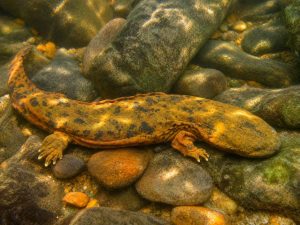
The Eastern hellbender, the largest salamander in the Americas, breathes through its skin, so the sediment that logging washes into a stream can smother it by clogging the pores it breathes through. The candy darter, a red and blue fish found only in West Virginia and Virginia, has already lost nearly half its known populations, and it needs clean gravel to spawn that silt buries. The other three live on land but hang on the same thread: the West Virginia northern flying squirrel, back from near collapse after 173,000 acres of forest were restored; the Cheat Mountain salamander, which dries out and dies without the shade of an unbroken canopy; and the Indiana bat, which spends its summers across nearly 40 percent of the forest. Intact forest is what keeps soil out of the streams and a roof over the ground. Open it up, and all five feel it.
Read the Full Article at Environment America
Why the Mon is our business
The Monongahela River starts in these hills and runs north into the Upper Ohio Basin. What logging does to the hellbender and the candy darter upstream, through sediment and lost shade, is the same thing that fouls the water the rest of us drink and fish downstream. We have written before about the fight over the Roadless Rule and what it means for our headwaters. This is the wildlife side of the same map, told well by people who went looking for the animals most of us will never see.
Summarized from “At-Risk Wildlife of the Monongahela National Forest,” by Ruby Mae Heathman (Environment America) and Cailey Beck (The Public Interest Network), published November 4, 2026. Read the original for the full profiles and photographs. Current as of November 20, 2026.