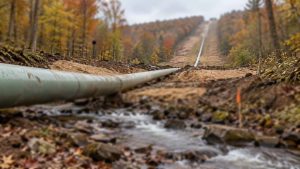
When the Senate comes back after the November 3 election, one of the first big bills waiting for it is a 417 page permitting package that would rewrite how the Clean Water Act works in practice. Our friends at Freshwater Now are sounding the alarm, and after reading the details, the concern holds up. Here is what the bill does, and why it matters in a basin where pipelines, power plants and data centers are all looking for water.
The Bipartisan American Affordability and Jobs Act was released September 30 by the leaders of two Senate committees: Shelley Moore Capito of West Virginia, Sheldon Whitehouse of Rhode Island, Mike Lee of Utah and Martin Heinrich of New Mexico. Its sponsors say it will speed up energy and infrastructure projects and lower costs. It would also narrow the power of states and Tribes to block or condition federal projects under Section 401 of the Clean Water Act, limit when EPA can veto a damaging fill permit, give the public 150 days to challenge many decisions in court, and double the maximum life of water pollution discharge permits from 5 to 10 years. The Bipartisan Policy Center expects a first procedural vote as early as November 9. It will need 60 votes.
What the bill changes for clean water
State and Tribal review gets much narrower. Section 401 is the part of the Clean Water Act that lets a state or Tribe review a federally permitted project, like a pipeline crossing, and approve it, attach conditions, or say no if it would harm local waters. The bill does not repeal Section 401, but it squeezes it hard. Reviews would be limited to direct water quality effects. A denial would require clear and convincing evidence that no change to the project could make it comply. Any conditions would have to be the least burdensome option, with the state carrying the burden of proof. For interstate gas pipelines and big transmission lines, review would shrink to direct discharges only, on a nine month clock.
EPA’s backstop gets a deadline. Today EPA can veto a dredge or fill site under Section 404 when it would cause unacceptable harm, even after the Army Corps has issued a permit. The bill would confine that veto to the formal review window before a permit is issued.
Nationwide permits last longer. General permits for oil and gas pipelines and other linear projects would run 10 years instead of 5, with some wildlife and historic preservation reviews skipped at renewal.
Pollution permits last longer, too. State issued discharge permits under the National Pollutant Discharge Elimination System (the permits that set how much a plant or treatment facility can release into a stream) could run up to 10 years. Every renewal is a chance to apply newer, tighter standards. Stretching the term means new protections take longer to reach the outfall pipe.
Fewer chances for the public to weigh in
The bill also changes who can go to court and how fast they have to get there. Challenges under the Clean Water Act’s fill permit program, the National Environmental Policy Act and the Endangered Species Act would generally have to be filed within 150 days. To sue over a NEPA decision, a person or group would usually need to have filed a comment detailed enough to put the agency on notice of that specific issue. Courts finding a flawed environmental review would send it back to the agency rather than throw out the approval.
For a small watershed association running on volunteers, that is a meaningful shift. The people most likely to notice a problem with a stream crossing are often the people least likely to have filed a technical comment months earlier.
The window the bill would set for most court challenges to fill permits, NEPA reviews and Endangered Species Act decisions.
The case the sponsors are making
It is fair to say what supporters want. Senator Lee has framed the goal plainly as making it easier to build things in America. Democrats backing the bill expect faster approvals for transmission lines, solar and batteries. Republicans expect relief for fossil fuel projects. The bill also adds new support for geothermal and hydropower. Permitting delays are a real frustration, and plenty of good projects have been tied up for years. The question for anyone who cares about water is whether speed has to come out of the hide of the Clean Water Act. Groups including the Environmental Law and Policy Center argue this bill makes exactly that trade.
“Make it easier in America to build things.”
Sen. Mike Lee, R-Utah, describing the goal of the bill, as reported by Heatmap News
Why it matters for the rest of us
All four of H2O’s states sit in the path of this bill. Pennsylvania, West Virginia and Ohio host a dense web of gas pipelines, and new data centers and power plants along the Ohio and the Mon are already lining up for water withdrawals and wetland fill permits. Section 401 reviews, discharge permit renewals and public comment periods are the tools local groups use to keep those projects honest. One of the bill’s lead sponsors represents West Virginia, which means basin voices carry real weight in this debate.
Pennsylvanians also hold something most Americans do not. Article I, Section 27 of the state constitution guarantees the people a right to pure water and makes the Commonwealth a trustee of its natural resources for this generation and the next. A federal bill cannot erase that right. But a right is only as strong as the people willing to use it, and the time to use it is before the vote, not after. Call your two U.S. senators, tell them what Section 401 and local permit reviews mean for your stream, and ask where they stand.
This article draws on an alert from Freshwater Now, the Bipartisan Policy Center’s explainer on the Bipartisan American Affordability and Jobs Act, reporting by Heatmap News, and a statement from the Environmental Law and Policy Center. Current as of October 22, 2026.