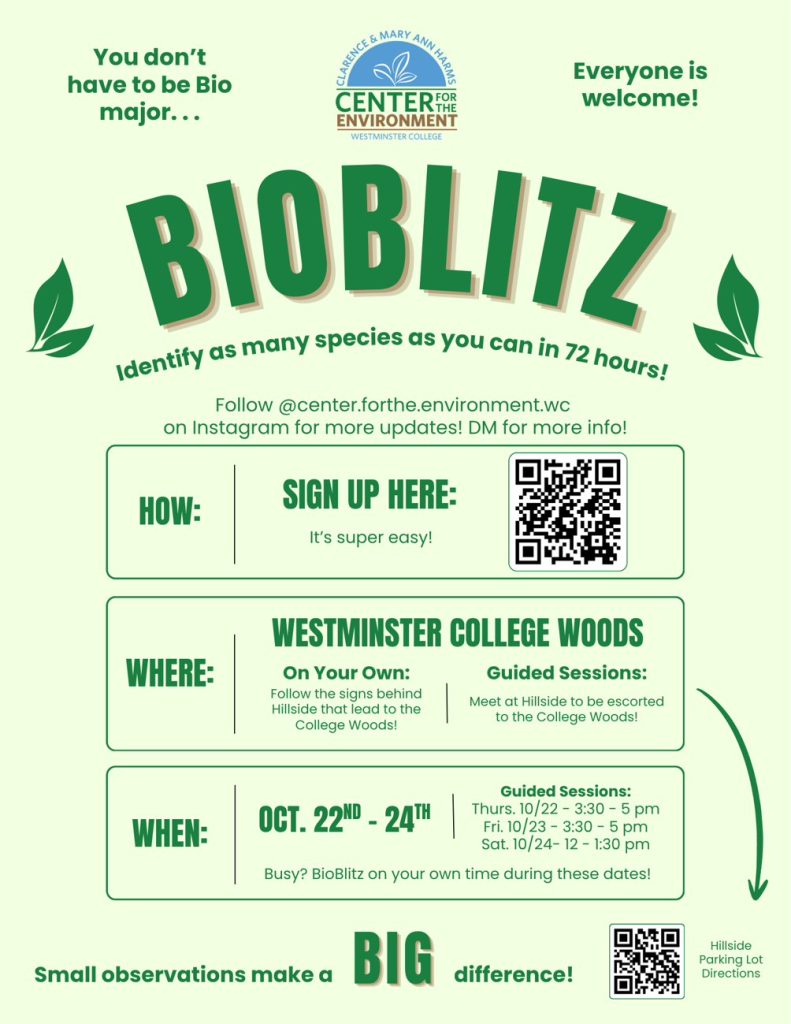
You do not have to be a biology major to be useful in the woods. For three days later this month, Westminster College is inviting anyone who wants to come to help count the living things in its College Woods, and the only skill required is a willingness to look closely. The Clarence and Mary Ann Harms Center for the Environment is running a BioBlitz from October 22 to 24, and everyone is welcome.
Westminster College’s Harms Center for the Environment is hosting a BioBlitz in the Westminster College Woods from Thursday, October 22 through Saturday, October 24. The idea is simple: identify as many species as you can over the 72 hours, whether that is a bird, a beetle, a mushroom, or a maple. You can join one of three guided sessions led out of Hillside, or do it on your own any time during those dates by following the signs behind Hillside to the woods. Sign up through the link on the event flyer, and follow the Center on Instagram at center.forthe.environment.wc for updates.
What a BioBlitz actually is
A BioBlitz is a short, all-hands effort to record as many living species as possible in one place and one window of time. Nobody is expected to know everything, and that is the point. A dozen people each noticing a different plant, insect, or fungus will together build a picture of the woods that no single expert could assemble alone. You photograph what you find, log it, and let the identifications come together. For students who have never thought of themselves as scientists, and for neighbors who just like being outside, it is about the lowest bar there is to doing real field biology.
How to take part
There are two ways in. If you want company and a little guidance, join a guided session: meet at Hillside at the start time and someone will walk the group out to the College Woods. Those run Thursday and Friday from 3:30 to 5 p.m. and Saturday from noon to 1:30 p.m. If your schedule does not line up, you can go on your own at any point during the three days by following the signs behind Hillside that lead to the woods. Either way, sign up first through the link on the flyer so the Center knows who is coming, park at the Hillside lot, and bring a phone or a camera to capture what you see. No special gear, no experience, and no major in biology required.
Why it matters for the rest of us
Biodiversity is one of the plainest signals we have of whether a place is healthy, and the woods and waters of this region are tied together more tightly than most people think. The same forests that shelter salamanders and songbirds also shade the headwater streams that feed our rivers, and a count of what lives in one patch of woods is a small piece of the baseline that tells us how the whole system is doing. Community science like this is how a region builds that baseline without a big budget, one observation at a time. So if you are anywhere near New Wilmington that week, go spend an hour looking closely at the ground. Small observations really do add up to a big difference.
Details from a Clarence and Mary Ann Harms Center for the Environment flyer for its BioBlitz at the Westminster College Woods, October 22 to 24, 2026. Updates and sign-up information are on the Center’s Instagram, center.forthe.environment.wc. Current as of October 8, 2026.